Over the past year I’ve seen an explosion of SaaS platforms promising what they call “automated SEO.” The idea is simple and very appealing: connect your website, let the tool handle keyword research, generate articles automatically, and sit back while search traffic grows.
On the surface it sounds like the logical next step for AI. In reality, most of these tools misunderstand what SEO actually is.
SEO Is More Than Just Publishing Content
Search optimisation isn’t just about producing content at scale. It’s about understanding why someone searches for something, what Google expects to rank for that query, and how that topic fits into the broader structure of a website. Those decisions require context, the kind that only comes from understanding a business, its audience, and its competitive landscape.
When automation platforms take over the process with autopilot SEO, that context usually disappears.
The Problem With Fully Automated Content Strategies
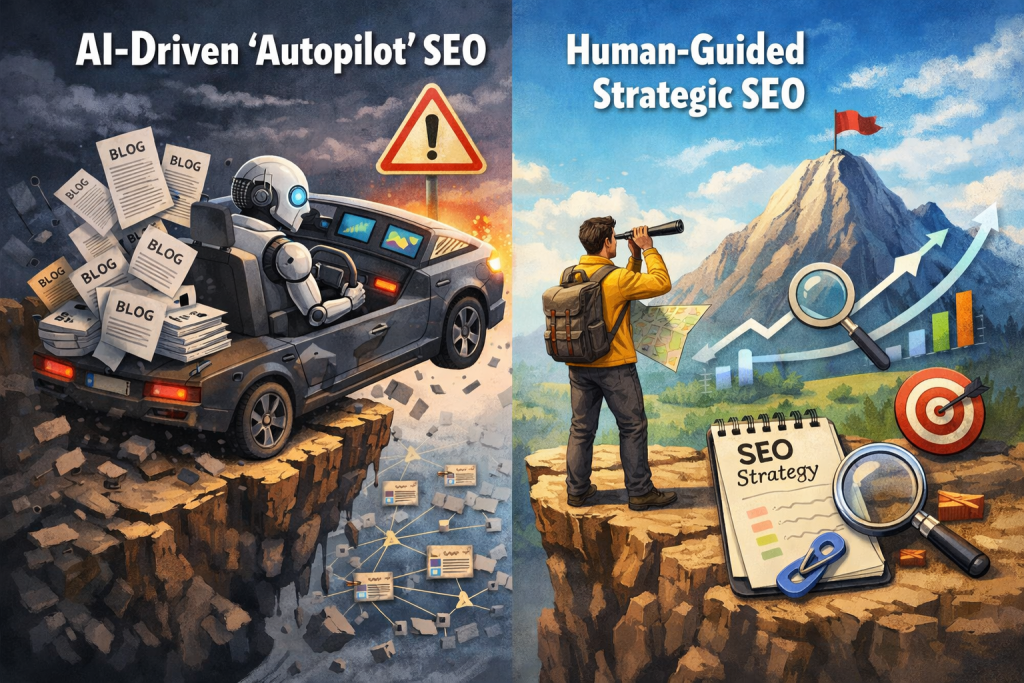
Instead of building a focused content strategy, these tools tend to generate large volumes of loosely related articles. The assumption is that if enough pages are published, a few will eventually start ranking. Occasionally that does happen, but it often masks a deeper problem. Over time the site becomes filled with overlapping topics, competing pages, and content that doesn’t really serve a clear purpose.
Why Search Intent Still Matters
Another issue is that many automated systems don’t analyse the search results properly. Experienced SEOs spend a lot of time studying the results page before creating content. They look at what types of pages are ranking, how competitors structure their information, and what level of authority is required to compete. Without that analysis, it’s easy to produce content that technically targets a keyword but doesn’t match what search engines are actually trying to show users.
The Reality of Automated Backlink Networks
Backlinks are often treated in a similar way. Some platforms promise automated link building through networks of participating websites. While this may increase the number of links pointing to a site, the quality and relevance of those links are often questionable. Search engines have become very good at recognising artificial link patterns, and links from unrelated sites rarely provide meaningful SEO value.
AI Doesn’t Understand Your Business
Perhaps the biggest limitation of automated SEO is that the software doesn’t understand the business it’s working for. It can’t evaluate which topics attract potential customers versus casual readers, or which keywords align with a company’s product and positioning. Without that perspective, traffic may increase but conversions often do not.
How AI Should Actually Be Used in SEO
None of this means AI is a bad tool for SEO. In fact, it’s extremely useful when applied correctly. It can speed up research, help structure content, and make workflows far more efficient. The difference is that the strategy still needs to come from someone who understands the market and the audience.
AI works best as an assistant that helps execute a plan. Problems arise when it’s expected to replace the planning itself.
SEO has never really been about publishing the most pages. It’s about publishing the right pages, the ones that genuinely answer a searcher’s question and support the goals of the business behind the site.
Automation can help with the work, but it shouldn’t be the one making the decisions.